
Patrick's Quick Answer
Selling on your own saves the listing commission on paper, but the real question is net proceeds: what you actually keep at closing. The decision comes down to whether you can match an agent on pricing accuracy, market data, marketing reach, negotiation, and the paperwork. In Texas, total seller costs typically run about 6% to 10% of the sale price, with commission the biggest line. Before you decide, let me show you the honest net-proceeds comparison for your home.
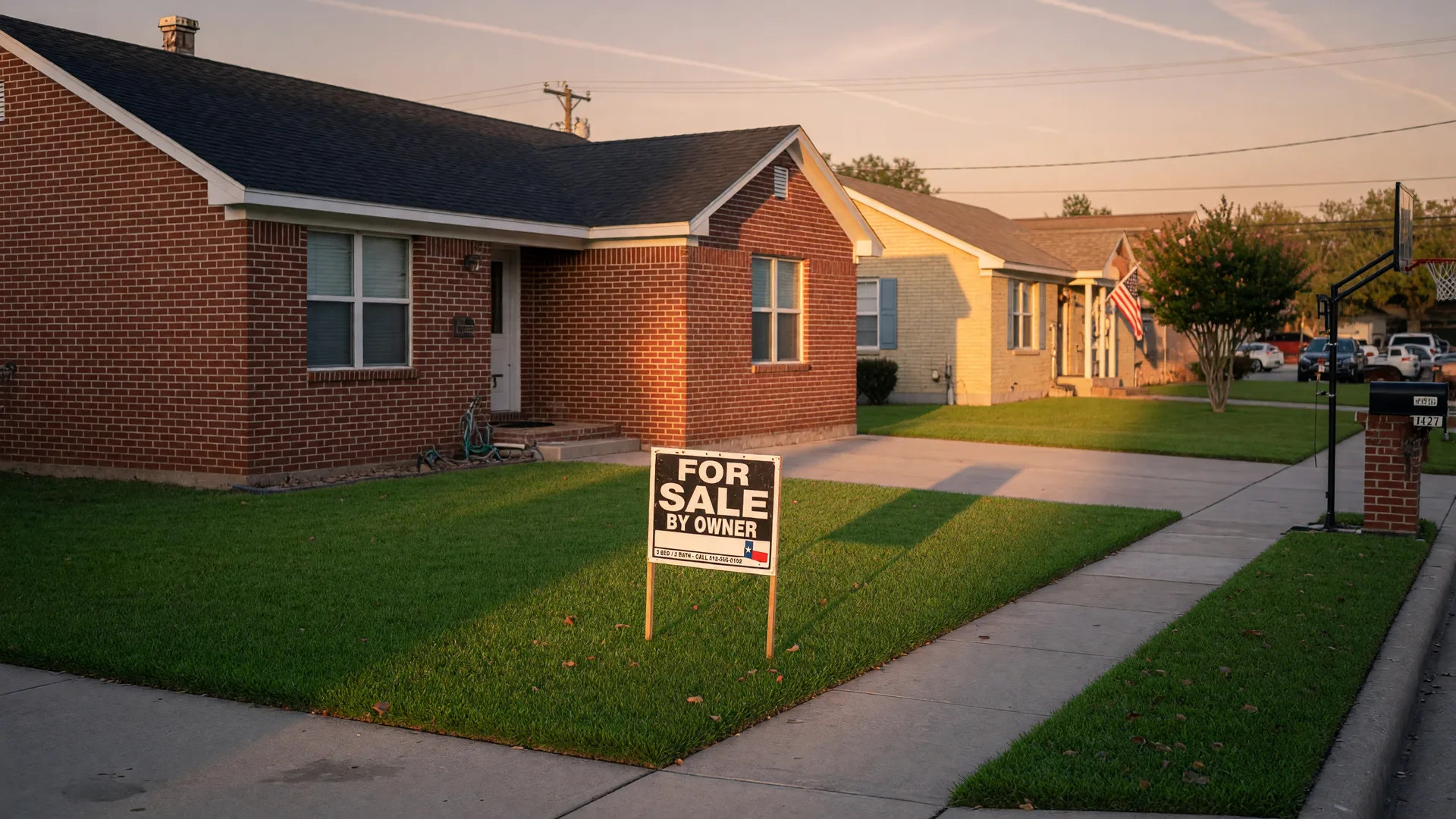
The FSBO (for sale by owner) question is really about one number: net proceeds, the money you actually keep after the sale. Selling without a listing agent can save the listing-side commission, but it only pays off if you can also price accurately, market broadly, vet offers, negotiate, and manage the inspection, appraisal, and closing paperwork well enough to net at least what an agent-backed sale would. This article lays out what an agent brings, the real costs of selling in Texas, and an honest framework for deciding which path fits your situation.
What FSBO actually saves you
Let us be honest about the numbers. The commission on a Texas home sale is negotiable and commonly runs in the 5% to 6% range total, split between the listing agent and the buyer's agent. As an FSBO seller, you can skip paying a listing agent, which can save roughly half of that, but most FSBO sellers still pay a buyer's agent commission, because buyer's agents are far more likely to bring their clients to homes where their fee is covered. On a $350,000 home, skipping the listing side might save around $10,000 on paper. The question is what that $10,000 costs you in a lower final price, a longer market time, or a deal that falls apart.
Pricing accuracy is the single biggest number
The most expensive mistake in any sale is the price, and it is where FSBO sellers most often lose the money they tried to save. A professional comparative market analysis uses recent closed sales of comparable homes, adjusted for size, condition, and upgrades, plus a read on current buyer demand. FSBO sellers often price from emotion, an online estimate, or what they owe, and both overpricing and underpricing are costly. Overprice and the home sits, then gets cut, and sells below a sharp price would have fetched. Underprice and you leave thousands on the table.
My seller cost article walks through the line items in detail. The short version: pricing right is worth more than the commission you might save.
Market data and marketing reach
Over 90% of buyers find the home they purchase online, and in San Antonio most of them start on the MLS and the major home sites, which feed from the MLS. Without MLS access, an FSBO home often gets far less exposure, limited to a yard sign, social posts, and the free sections of listing sites. A listing agent plugs your home into the full MLS, syndicates it everywhere, and gets it in front of the buyer's agents who control where their clients look. In a balanced market with 6-plus months of inventory, that reach is not optional, it is what gets the home seen in the first place.
Professional photos and staging guidance
Presentation sets the tone for every showing. Professional photography, a clean and de-personalized interior, and a strong front entry photograph measurably increase views and showings compared to phone photos and a cluttered house. A good agent also guides you on the low-cost staging that moves the needle and flags the small repairs that protect your price. These are the first-impression investments that separate a home that sells in weeks from one that sits.
Offer vetting and negotiation
Negotiation is where a professional earns the fee. An agent compares offers on more than price: financing strength, down payment, appraisal gap coverage, option period and inspection terms, earnest money, and timeline. They also run the negotiation with a steady hand, pushing for the best terms without blowing up the deal. As an FSBO seller facing a buyer's agent, you are negotiating against a professional with more experience, and every concession you give comes out of your net proceeds. If you have never negotiated a Texas real estate contract, this is the steepest part of the learning curve.
Managing inspections, appraisal, and closing
Between contract and closing sit the inspection, the option period, the appraisal, repair requests, and a stack of deadlines and disclosures. Miss one deadline or mishandle a repair request and you can lose a buyer, or the earnest money. In Texas there is no attorney required at closing, so the title company handles the settlement, but someone still has to manage the process, review the settlement statement, and keep the deal on schedule. This is where FSBO sales most often fall apart after the hard part is done.
The real seller costs in Texas
Here is the honest picture of what selling costs in Texas. Total seller costs typically run about 6% to 10% of the sale price, and the breakdown matters:
- Commission: fully negotiable, no set rate, but commonly around 5% to 6% of the sale price total, and the biggest line.
- Owner's title insurance policy: customarily seller-paid in Texas, state-regulated, often roughly $2,000 to $3,500 on a mid-priced home.
- Title and escrow fees: the seller's share typically a few hundred dollars up to about $1,500.
- Prorated property taxes: your share through the sale date, calculated at closing.
- Concessions: seller credits to the buyer, capped by the buyer's loan program (roughly 3% to 9% conventional, up to 6% FHA, up to 4% VA).
- No state transfer tax: Texas does not charge one, which keeps the list shorter than in many states.
The wide 6% to 10% span is almost entirely commission structure and concessions, which is exactly where an agent's negotiation and pricing strategy show up in your net proceeds.
When FSBO can work, and when it gets expensive
FSBO makes the most sense when the sale is simple: you have the time, the market knowledge, a clear idea of value from recent sales you can verify, and a buyer already in hand, such as a family member. It gets expensive when you are new to the process, pricing without sold data, negotiating against a buyer's agent, or managing a complicated transaction alone. There is nothing wrong with a well-executed FSBO. The honest question is whether you have the data, reach, and experience to net more than an agent-backed sale, and the only way to answer it is to see both paths side by side.
The dual-license edge: as both a REALTOR and a loan officer, I price, market, and negotiate your sale, and I can also verify that your buyer can actually close. That means fewer fallen deals and a net-proceeds projection you can trust, which is the whole point of comparing FSBO vs. an agent in the first place.
Frequently Asked Questions
Do FSBO sellers still pay a buyer's agent commission in Texas? Tap to expand
What is the biggest way FSBO sellers lose money? Tap to expand
How much does it cost to sell a house in Texas in total? Tap to expand
Can I list on the MLS without an agent? Tap to expand
More Seller Resources From Patrick
Articles to help you understand the real cost and the real value.
How Much Does It Cost to Sell a House in Texas?
Every seller line item explained
Do I Need a Realtor to Sell My House?
FSBO responsibilities and disclosure duty
How to Sell My House Fast in Texas
Pricing, condition, and timing that work
Highest Offer or Strongest Buyer?
How to compare offers that actually close
See the real net-proceeds comparison
The honest way to decide is to see the numbers. Book a no-pressure consultation for a free valuation of your home, and I will show you what an agent-backed sale would likely net versus selling on your own. You owe it to yourself to make the decision with real data, not a guess.

Patrick Kevin Fagan
Loan Officer and Realtor | AXEN Realty LLC | San Antonio and Texas Hill Country
Licensed Sales Agent | 454749 | TX
Sincerely, Patrick Kevin Fagan
Seller cost figures (6% to 10% total, common 5% to 6% commission range, owner's title policy range, no Texas transfer tax) reflect published 2025/2026 sources including Texas Real Estate Commission guidance and market surveys; concession limits reflect published 2026 program guidance. Ranges are typical, not a quote for any specific home.