
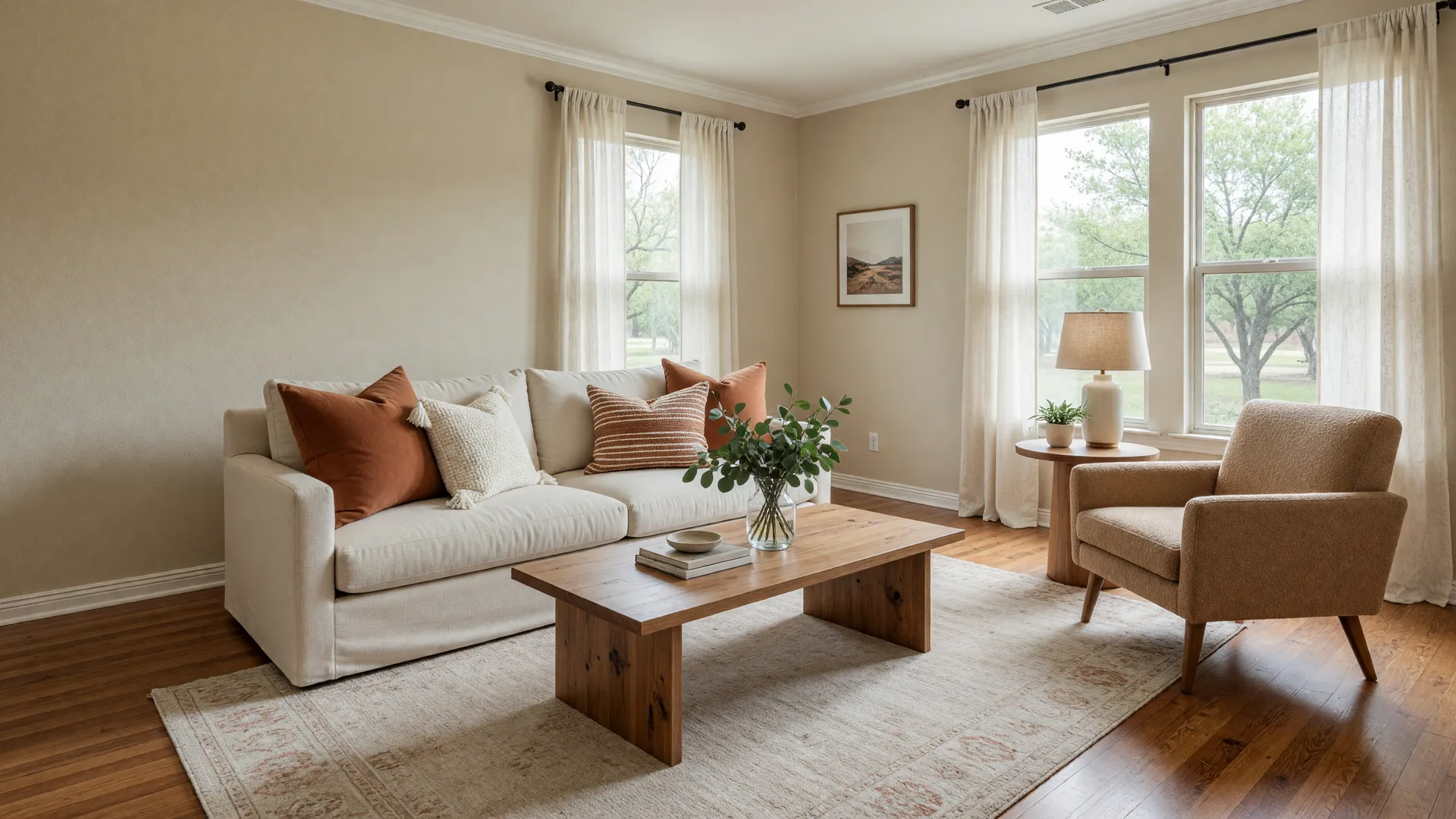
Staging is not about decorating, it is about helping a buyer see themselves living in the home, and the payoff is a faster sale at a stronger price. National agent surveys consistently report that staged homes sell more quickly than unstaged ones, and buyers gravitate to move-in-ready properties. The good news for Texas sellers is that most high-impact staging is cheap or free: declutter, depersonalize, fix the obvious, and let the light in. Here is the room-by-room plan I give every seller I work with in San Antonio and the Hill Country.
Want the deeper version? My home staging answer covers the process in detail, and the preparing your home to sell guide has a full checklist.
1. Start outside: the curb is the first showing
In Texas, buyers often drive by before they ever book a showing. Mow, edge, trim the shrubs, clear the walkway, and pressure-wash the porch and siding if they need it. Add a fresh doormat and a simple pot of seasonal color near the front door. The front door itself is worth fresh paint or a good cleaning, because it is the last thing a buyer touches on the way in. A tidy yard says the whole house is cared for, which is exactly the message you want to send before anyone steps inside.
2. Declutter and depersonalize first
Before any decorating, remove about a third of your furniture and most of your personal items. Buyers need to picture their own furniture, their own family photos, their own life, and they cannot do that in a room full of your stuff. Box up collections, clear countertops to just a few items, and put away everything from medicine bottles to appliance magnets. Closets matter too: an overstuffed closet reads as not enough storage. Thin them out so they look organized and roomy.
3. Fix the obvious, even if it is small
Buyers notice dripping faucets, sticking doors, cracked switch plates, and burned-out bulbs, and they translate small flaws into worries about big ones. Walk the house with a notepad and fix the cheap things before the first showing: touch up paint, tighten hardware, replace worn outlet covers, and make sure every light works. You do not need a remodel. You need the home to look maintained, because move-in-ready is what the data says buyers want.
4. Let the light in and keep it neutral
Open the curtains, clean the windows, and turn on the lamps for photos and showings. Bright, airy rooms photograph better and feel bigger in person. If any wall color is strongly personal, a coat of a neutral, warm tone is the cheapest transformation on the list. The same goes for the Texas spaces buyers care about most: the kitchen and the primary bathroom. Clear the counters, put out a bowl of fruit or a small vase, fold the towels neatly, and scrub the grout. Those two rooms move decisions more than any others.
5. Do not forget the Texas rooms
If your home has a covered patio, a backyard, a pool, or a big Hill Country view, treat it as a selling room. Stage the patio with clean outdoor furniture, sweep the pool deck, and make the outdoor living space look like somewhere someone would actually spend a Texas evening. For acreage or Hill Country homes, the outdoor space and the view are often the reason someone is buying the property at all, so it deserves the same care as the kitchen.
The budget reality
Full professional staging can be a worthwhile investment on higher-priced homes, but the vast majority of the payoff comes from the free and low-cost steps: decluttering, cleaning, fixing, and letting the light in. If you are on a tight budget, do those steps thoroughly, invest in professional photography, and price the home right from day one. That combination is what actually sells homes in this market.
My seller walk-through: before we list, I come through your home with a fresh eye and a checklist, and I will tell you straight which staging steps move the needle and which ones are a waste of money for your specific home and price range.
Frequently Asked Questions
Does staging really sell homes faster? Tap to expand
How much does it cost to stage a house? Tap to expand
Do I need to renovate before selling? Tap to expand
Should I stage my empty home? Tap to expand
Prepare Like a Pro
More seller prep resources from Patrick.
Let me walk your home with a seller's eye
I will tell you exactly which staging steps to prioritize for your price range and neighborhood, so you spend time and money only where it moves the sale.

Patrick Kevin Fagan
Loan Officer and Realtor | AXEN Realty LLC | San Antonio and Texas Hill Country
Licensed Sales Agent | 454749 | TX
Sincerely, Patrick Kevin Fagan