
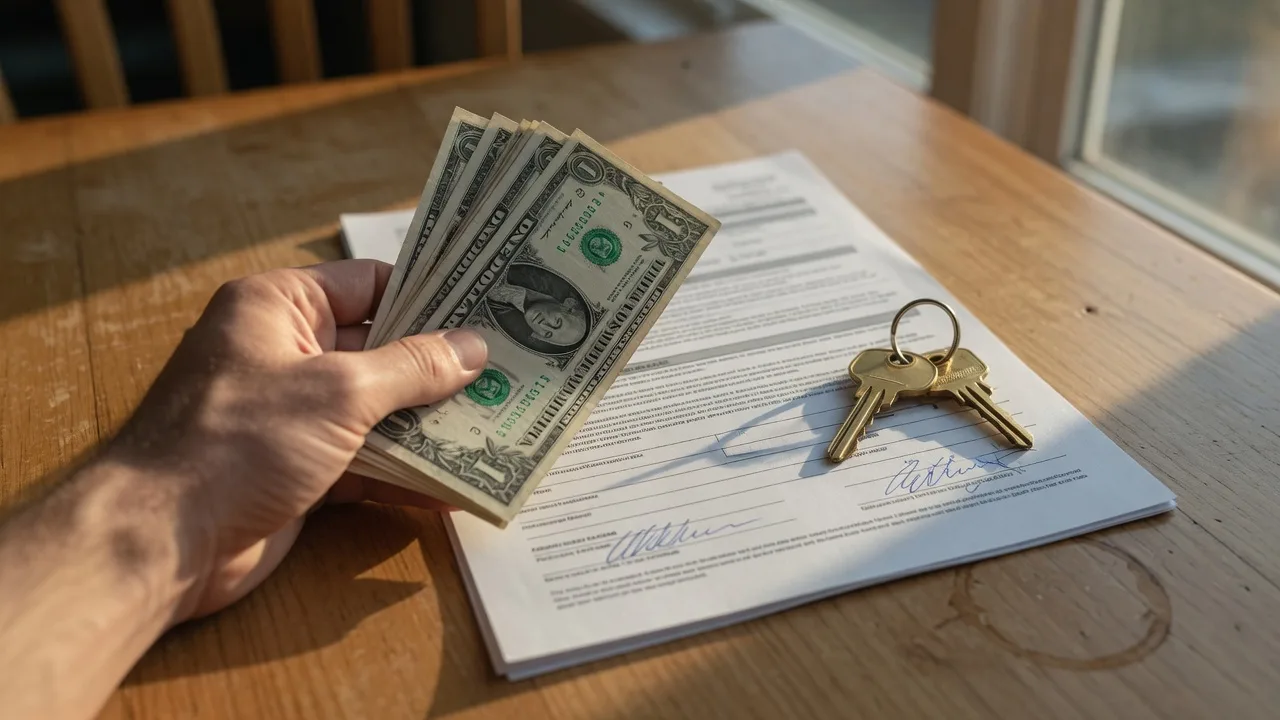
Patriot Nation, the "$1,000 down" story is my most-asked question on YouTube, and the honest answer has two halves. Half one: the math genuinely works on the right deal. Half two: the strategy has real prerequisites that the headline never mentions. Let's break it down so you know exactly where you stand.
Before you tour a single home, get the eligibility check.
Credit, income limits, and collections history decide whether the $1,000-down structure is even on the table for you. I check all three in one sitting.
The machine behind the number
Your cash to close is really three buckets: the down payment, the transaction costs, and the prepaids. The $1,000-down strategy attacks all three at once:
- FHA at 3.5% down. On $300,000, that is $10,500 in the down payment bucket, the cheapest conventional-adjacent entry short of zero-down programs.
- Seller concessions up to 6%. FHA allows seller-paid costs up to 6% of the sales price, so about $18,000 can be directed at closing costs, prepaids, and program fees.
- Down payment assistance. Texas programs like TSAHC Home Sweet Texas and My First Texas Home can deliver up to 5% of the loan toward the down payment and closing costs, with income and price caps.
My full step-by-step on the exact structure lives in the $1,000 cash to close breakdown, and the FHA zero-down playbook shows the same engine on a smaller price point.
Example math on the $300,000 purchase
Rounded example, not a quote
This is a labeled teaching example to show how the buckets combine. Actual results depend on program limits, the DPA rate trade, closing costs, the appraisal, and the seller's answer. Every dollar must appear on the Loan Estimate.
Here's the key: the concession cap and the assistance cap are ceilings, not guarantees. A seller in a hot multiple-offer situation can simply say no, and price caps on assistance programs mean the math only works inside a price range. The strategy needs a market where concessions are normal, and right now much of San Antonio is exactly that kind of balanced market.
The prerequisites, listed like an honest checklist
- Credit: the FHA floor is around 580, but most DPA programs want 620 to 640 to pair cleanly. Higher scores also mean better pricing, which matters when you are thin on cash.
- Payment history: limited collections and minimal 30-day lates. FHA underwriting is strict about recent late payments, so clean history is a real prerequisite, not a suggestion.
- Debt ratios: the added assistance and insurance still have to fit inside the DTI guidelines, so the payment must fit your income.
- Program income caps: DPA limits are county and household size based. Earning too much disqualifies the assistance, ironically.
- A cooperating seller and a solid appraisal: the deal only exists if the seller grants concessions and the appraisal supports the price.
The credit piece alone eliminates a lot of hopeful buyers, which is why I screen it first. If your credit needs work, the credit hacks guide and my 60-90 day credit plan should come before the house hunt.
Reality check: this is not for everyone, and I will tell you straight.
If the structure fits, we build it. If it does not, I show you the honest path to get there, whether that is credit repair, a different program, or a different price range.
When to walk away from this strategy
- No savings beyond closing: buying with near-zero cash to close but zero reserves after is a gamble. Homes need repairs, and the first HVAC surprise should not be a credit card.
- Credit not ready: if the credit site says 600 but the file shows recent lates and collections, forcing the deal means a worse rate on a long loan. Fix the file first; a 90-day plan beats a 30-year regret.
- A seller who refuses concessions: without the concessions, the stack collapses. Move to the next house rather than overpay because of sunk cost.
- Appraisal pressure: if the home will not appraise, the financing fails; never waive the appraisal contingency to save $1,000 of cash.
The three-bucket framework that makes this whole strategy legible is in the cash to close guide, and the buy without a down payment Q&A covers the zero-cash variations.
Frequently Asked Questions
Can you really buy a house with $1,000 down? Tap to expand
What do I need to qualify for the $1,000 down strategy? Tap to expand
How does $10,500 of down payment get covered? Tap to expand
Is the $1,000 down strategy risky? Tap to expand
Is this strategy for everyone? Tap to expand
$1,000 down is a headline. The real story is the plan.
I will tell you honestly whether the structure fits you, show you the exact cash-to-close number on a real house, and build the 90-day plan if you are not there yet. On your side, always.
About Patrick Kevin Fagan, REALTOR®
Patrick Kevin Fagan is a Texas Real Estate Sales Agent (#454749) with AXEN Realty LLC and a Senior Loan Officer (NMLS ID #877741) with NEXA Mortgage, LLC (NMLS #1660690). He brings 23+ years in mortgage lending and 19 years in real estate, serving homebuyers, homeowners, and sellers across Greater San Antonio and the Texas Hill Country.
Answered by Patrick Kevin Fagan
Texas Real Estate Sales Agent #454749, AXEN Realty LLC · Senior Loan Officer, NMLS ID #877741, NEXA Mortgage, LLC
Call or text: 210-317-6514
Concession caps, DPA availability, and credit rules reflect published 2026 program figures and change by county and funding cycle. All dollar figures are labeled teaching examples, not quotes or guarantees.
