
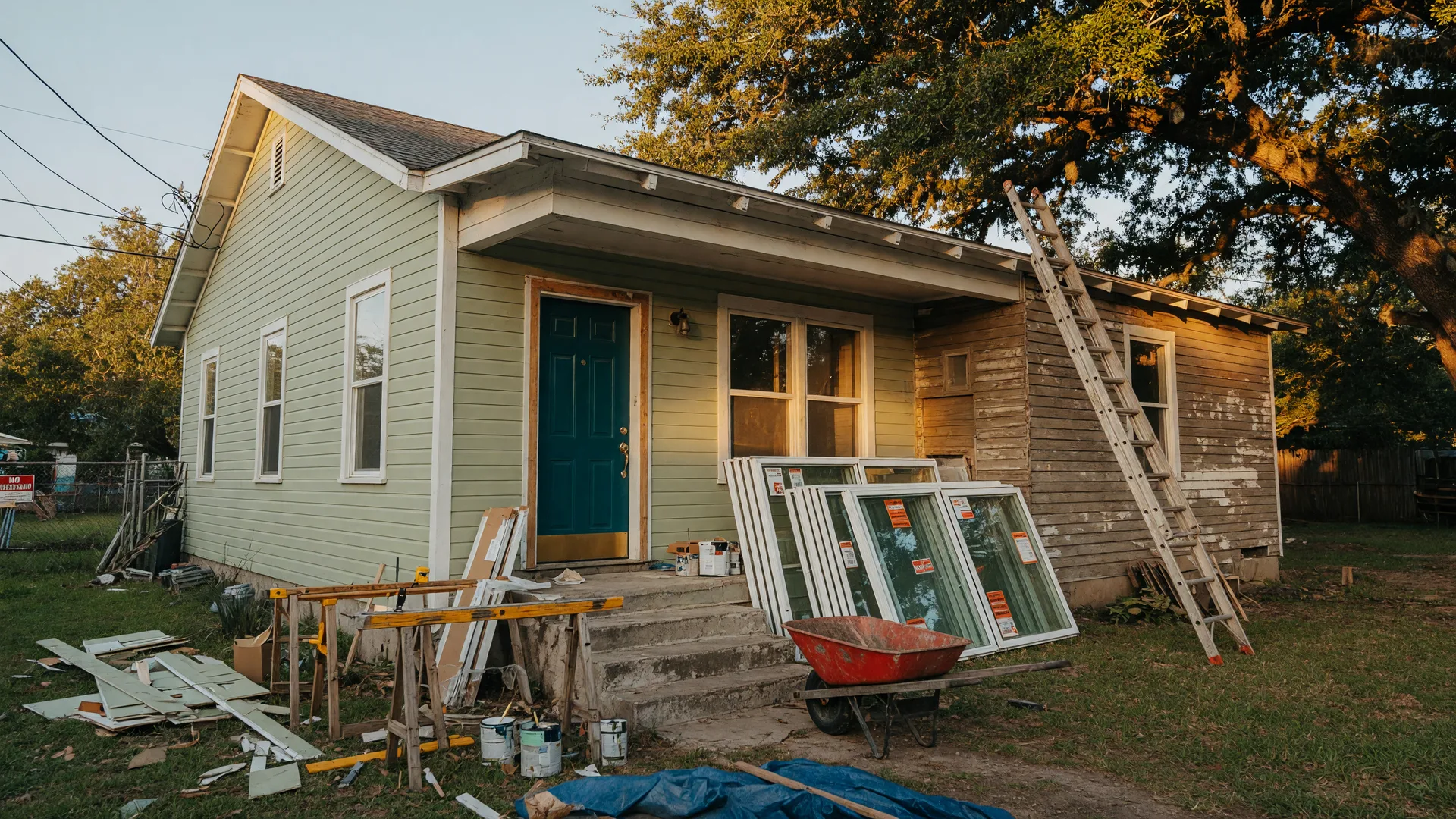
Patriot Nation, every market has them: the fixer with the terrible kitchen and the great location, priced thousands under the renovated homes down the street. Most buyers walk because they think they need cash for renovations on top of a down payment. You do not. Renovation loans like the FHA 203(k) were built exactly for this, and San Antonio and the Hill Country are full of properties where the strategy makes real sense. Here is how it works in 2026.
Found a fixer? Send me the address and the work list.
I will tell you which flavor of renovation loan fits, what the payment looks like with the repairs financed, and the realistic cash you still need at closing.
The two flavors of FHA 203(k)
The FHA 203(k) comes in two versions, and choosing wrong is the most common mistake I see. Here's the difference:
- Limited 203(k): for minor, non-structural repairs and upgrades like kitchens, baths, flooring, paint, roofing, HVAC, and appliances. The cap on total rehabilitation cost is $75,000 in 2026, raised from the old $35,000 limit, and energy improvements can go on top. No HUD consultant required. This is the workhorse for 90% of first-time buyers.
- Standard 203(k): for major and structural work, including additions and foundation work, with no repair-cost cap inside FHA county loan limits. It needs at least $5,000 in repairs and always requires a HUD-approved 203(k) consultant, whose fee (commonly a few hundred to about $1,000) is added to the loan.
On the conventional side, the Fannie Mae HomeStyle loan plays the same game with a different referee: it pairs with a conventional mortgage, typically wants a higher credit score and more down (5% is common), and swaps the HUD consultant for lender-managed oversight with more flexible rules in some cases. My renovation loans and instant equity guide compares the full family of options.
What the repair money can cover
The list of eligible work is broad: structural repairs, roofing and gutters, HVAC, plumbing and electrical, kitchens and baths, flooring, paint, appliances, accessibility improvements, and even landscaping and a pool under the right program rules. What it does not cover is the fun stuff: no luxury upgrades beyond program discretion, no DIY labor, and the property must end up meeting FHA condition standards.
Rounded example, not a quote
Let's put a real shape on it. Say you buy a $300,000 fixer and the bid list comes to $30,000 for the kitchen, flooring, and a roof. With a Limited 203(k), the loan is built on the total of about $330,000. At the FHA 3.5% down requirement, your down payment math runs near $11,550, and the $30,000 repair budget sits in a rehabilitation escrow, paid to contractors in draws as work is inspected.
Final numbers depend on the appraised after-repair value, your rate, taxes, and insurance, and FHA county loan limits. The example shows the shape, not a quote.
Contractor rules: hire licensed, plan the draws
This is where renovation loans trip up buyers who are used to weekends with a hammer:
- Licensed contractors only. Work must be done by qualified contractors, licensed where state or local law requires it, and bids must meet FHA guidelines. Your own labor generally does not count.
- Money is escrowed, not handed over. The repair funds go into a rehabilitation account at closing and are released in draws after inspections confirm the work. The Limited program now allows up to four draws per contractor, and Standard allows more, so the cash follows the work.
- Timeline discipline. Work typically starts within 30 days of closing and must finish within the program's allowed window, usually about six months. That is a tight rodeo for a big remodel, so the schedule should be realistic before you commit.
- Contingency cushion on Standard. The Standard 203(k) holds a 10% to 20% contingency reserve for surprises that can only be spent on necessary, unforeseen repairs.
The escrow structure is actually your friend: it stops the classic fixer failure of paying a contractor upfront and watching the work stall. My when to use a renovation loan answer digs into the decision timing.
Who this fits in San Antonio and the Hill Country
San Antonio has whole neighborhoods where the renovation-loan playbook shines: older established areas with good bones and tired finishes, plus Hill Country properties where the land and location carry the value. The strategy fits:
- First-time buyers willing to live through a remodel to buy below the renovated comps and build instant equity.
- Owner-occupant investors buying a two-to-four unit fixer, living in one unit, and renting the rest.
- Buyers priced out of move-in-ready in their preferred San Antonio neighborhood.
- Sellers-about-to-be who bought generic and now want their next home customized from day one.
The honest catch: the appraisal works on the after-repair value, so you need a realistic scope and a lender who knows how to structure the draw schedule. That combination is rare and valuable, and it is exactly what I do as both your loan officer and your agent.
Let's price the fixer with the work included.
I model renovation loans on the actual house and the actual bid list, so you see the real payment and the real cash to close before you write an offer.
The instant equity, in one sentence
When a tired house needs $30,000 of work and the renovated comps sell $60,000 higher, financing the work at today's rates can hand you equity the day the paint dries. That is the "ugly house hack," and it works in our market when the scope is honest and the contractor list is real. For the full framework on how renovation loans create equity, my instant equity explainer is a must-read.
Frequently Asked Questions
What is the difference between Limited and Standard 203(k)? Tap to expand
How much can I borrow for repairs with a 203(k)? Tap to expand
Do I need to hire a contractor for a 203(k) loan? Tap to expand
How is the repair money held and paid out? Tap to expand
Is a 203(k) better than Fannie Mae HomeStyle? Tap to expand
The ugly house is just a house waiting for the right loan.
I close renovation loans in San Antonio and the Hill Country, and I also negotiate the fixer for you as your agent. One team, purchase plus repairs, from first offer to final draw.
About Patrick Kevin Fagan, REALTOR®
Patrick Kevin Fagan is a Texas Real Estate Sales Agent (#454749) with AXEN Realty LLC and a Senior Loan Officer (NMLS ID #877741) with NEXA Mortgage, LLC (NMLS #1660690). He brings 23+ years in mortgage lending and 19 years in real estate, serving homebuyers, homeowners, and sellers across Greater San Antonio and the Texas Hill Country.
Answered by Patrick Kevin Fagan
Texas Real Estate Sales Agent #454749, AXEN Realty LLC · Senior Loan Officer, NMLS ID #877741, NEXA Mortgage, LLC
Call or text: 210-317-6514
203(k) caps, fees, and rules reflect published FHA figures in effect for 2026 and are subject to change. All dollar figures in examples are labeled teaching figures, not quotes or guarantees.
