
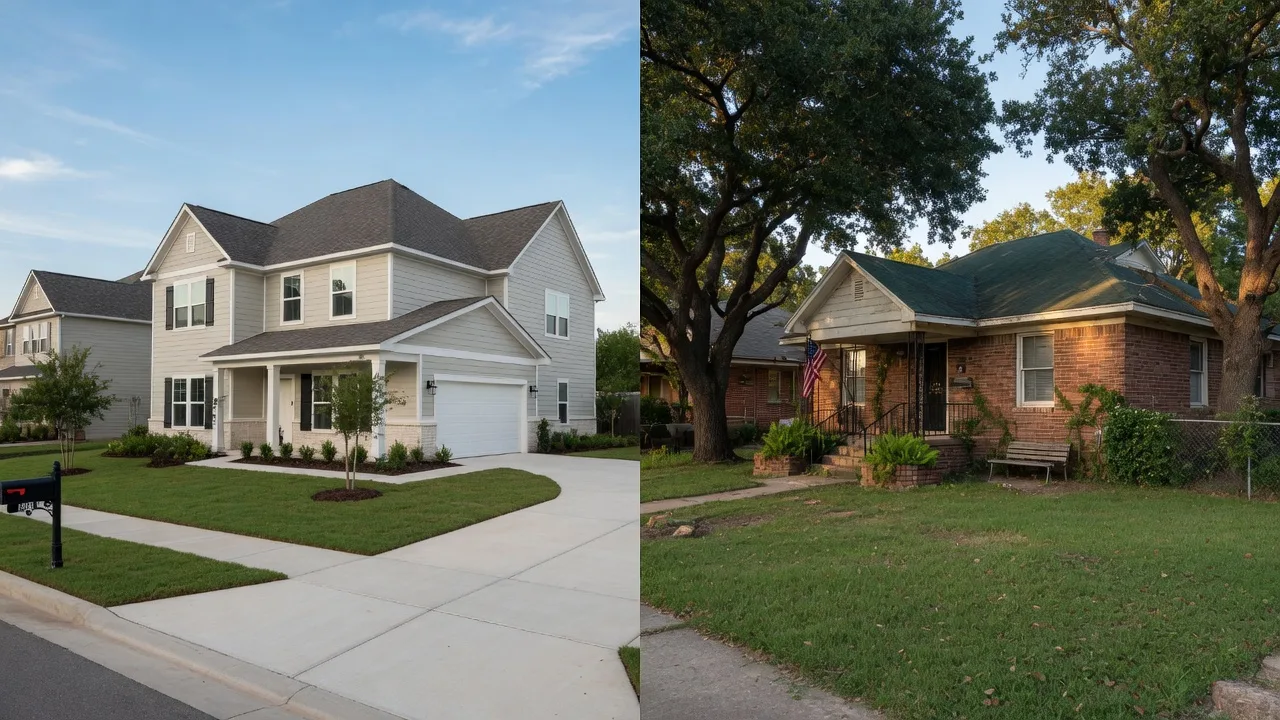
Patrick's Quick Answer
Here is the short version. A new build gives you brand-new systems, builder price and incentives, a set delivery timeline, and no competing bids on that specific lot, but you wait for construction and pay extra for upgrades, landscaping, and fencing. A resale gets you move-in-ready condition in an established neighborhood, often on a faster schedule, but you may inherit repairs and face bidding on the best-priced homes. Neither is automatically better. The right pick comes down to your timeline, your cash position, and how much work you want after you get the keys.
I get this question almost every week, usually from a San Antonio buyer who has toured a few model homes in a new subdivision and a handful of resales on the same Saturday. Both routes can work great in 2026. Let's break down what each one really involves so you can decide with your eyes open.
What "new construction" and "resale" really mean here
New construction means you are buying from a builder, usually a tract builder in a master-planned community, a semi-custom builder on your own lot, or a custom builder where you control most of the plan. Resale means the home already exists and you are buying it from its current owner.
Both exist everywhere in Greater San Antonio, from Stone Oak and the 1604 corridor to Bulverde, Spring Branch, and New Braunfels. The point is not that one type is good and the other is bad. You are really comparing two different ways to spend the same budget.
The 2026 San Antonio new-home market
The new-home side of this market has shifted. Early in the cycle, builders stopped discounting and kept waiting lists. In 2026, builders across the metro are competing again: rate buydowns, closing-cost credits, and standard features thrown in as incentives have come back in many communities. That is good news if you are comparing new construction seriously. Builders are motivated to move the homes they have under construction and put new ones in the ground.
The catch is that incentives live in the fine print. A low advertised base price can come with lot premiums, structural options, and upgrades that push the real number well past the sign in the front yard. Many builders will be flexible on the home price in this market, but upgrades are where the margin lives.
Here's the key: in 2026, the strongest negotiation on a new build is often about the total package, incentives, rate buydown, closing costs, and included features, not just the base price. Ask the builder for the full "everything included" total before you compare it to a resale.
What you control vs. what you don't
With a new build you control finishes: you pick the countertops, flooring, tile, and layout, subject to the builder's menu and deadlines. With a resale you control the negotiation: you can ask for repairs or a seller credit, and everything is visible upfront because the home is sitting there for you to inspect.
Flip it around and you see the downside of each. On a new build, the design studio upgrade menu is how builders make margin, and changes after a certain point are expensive or impossible. On a resale, you are buying the previous owner's taste and maintenance record, so an inspection and a careful review of age and condition matter a lot.
Costs beyond the price tag
Both choices have a second spend that doesn't show up in the listing price.
- New builds: budget for lot premiums on the better lots, the upgrade list, window themself, appliances beyond the standard packages, and anything outside the walls, landscaping, fencing, gutters, garage build-outs, window treatments, and usually a refrigerator. On acreage lots in the Hill Country, septic, water well, and utilities can also be part of the builder package, so read the contract closely.
- Resales: budget for the inspection and the items it finds. Age of roof, HVAC, and water heater, plus deferred maintenance, show up fast in the first two years. Some of that you can negotiate, some you will own.
Builders in the Hill Country and outlying areas often sell lots with water and sewer taps included, but not always. Get the breakdown in writing and compare it to a resale in the same ZIP, where utilities, fencing, and landscaping already exist.
Timeline and financing
This is where the two paths really separate. A resale in 2026 can close in roughly 30 to 45 days if everything goes smoothly. A new build under construction typically runs several months, sometimes a year or more depending on the stage, the builder's schedule, and supply chain reality.
From a financing view, your pre-approval has to cover the completion date, not the signature date. If you get pre-approved on a rate that expires in 60 days and the house isn't finished for nine months, you will be re-qualified at the end, rates and all. That is why a lender who understands the new-construction process matters as much as the builder's own financing arm.
A few other loan details to know. Some builders push their preferred lender with a credit; it can be a great deal, and you should always check it against your own quote. FHA and VA appraisals and the builder's timeline are also negotiated clearly in the contract. And the deposit structure on a new build is different from earnest money on a resale, so your team should be across the contract before you sign. I walk through the full new-build process in my new construction guide.
Not sure which path your loan supports?
That is exactly the conversation I run with buyers before they start touring. Bring me the two homes you are torn between, and I will show you the true out-the-door cost of each, including upgrades, incentives, and cash-to-close, so the decision writes itself.
Which fits first-time buyers
Both work for a first-time buyer, so the honest answer depends on your preferences and your deadline.
- First-time buyers who like the new build route tend to value simplicity: nothing to fix, the builder's warranty windows (often one year on workmanship, two on systems, ten on structure), and transparent pricing with incentives. The risk is their cash position: upgrades and the closing timeline stretch both.
- First-time buyers who prefer resale tend to value price, location, and immediacy. An existing home in an established neighborhood with good schools can buy a lifestyle that a new build on the edge of town can't. The risk is unexpected maintenance and the repair-negotiation process.
For a first-time buyer, my honest guidance: if you can wait and want zero maintenance, new construction with a smart upgrade list wins. If a fixed close date and an established neighborhood are more important, resale wins. Both are about to be funded with the same payment components, and I go through those line by line in my how much house can I afford guide.
Frequently Asked Questions
Are new builds more expensive than resales in San Antonio in 2026? Tap to expand
Can I negotiate a new construction price? Tap to expand
Does the same loan type work for new and resale homes? Tap to expand
Advice for building a new home in New Braunfels today? Tap to expand
Let's put both options on paper.
I am a dual licensed loan officer and Realtor, so I can run the true cost of a new build and a resale side by side, with the financing that fits each one. Get the comparison before you make an offer. Contact me or call 210-317-6514.
About Patrick Kevin Fagan, REALTOR®
Patrick Kevin Fagan is a Texas Real Estate Sales Agent (#454749) with AXEN Realty LLC and a Senior Loan Officer (NMLS ID #877741) with NEXA Mortgage, LLC (NMLS #1660690). He brings 23+ years in mortgage lending and 19 years in real estate, serving homebuyers, homeowners, and sellers across Greater San Antonio and the Texas Hill Country.
Answered by Patrick Kevin Fagan
Texas Real Estate Sales Agent #454749, AXEN Realty LLC · Senior Loan Officer, NMLS ID #877741, NEXA Mortgage, LLC
Call or text: 210-317-6514
Figures in this post are directional market ranges and rounded examples, not a quote or a guarantee. Neighborhoods, builder programs, and loan files vary. Get your own written numbers from a licensed loan officer and agent before you commit.
