
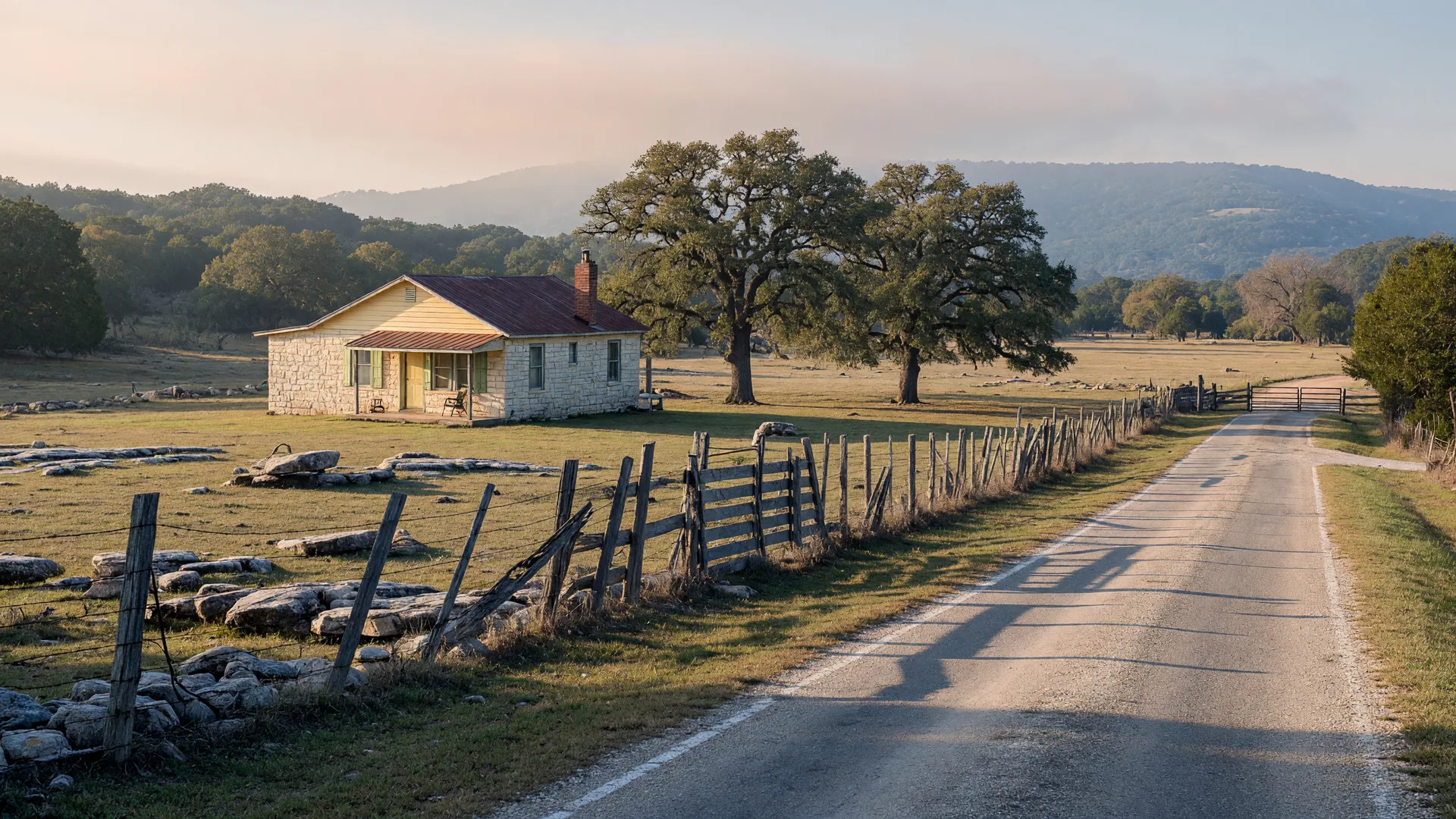
Patriot Nation, let's talk about the quietest great loan program in Texas. The USDA Rural Development guaranteed loan is zero down, has no monthly PMI, and carries an annual guarantee fee of just 0.35%, yet a lot of Hill Country buyers never consider it because they assume they do not qualify. Here is the truth about where it works, who it fits, and the 2026 numbers that decide it.
Not sure if your address qualifies? I check the map with you.
Bring the county or the neighborhood you are looking at, and I will tell you whether USDA is in play before you tour homes that may not qualify.
The zero-down part is real
USDA is one of the last true zero-down loans in the country. FHA wants 3.5% down, conventional wants something for most buyers, and VA is zero down but needs military eligibility. USDA is zero down for ordinary working families who buy in an eligible rural or suburban area. On a $350,000 Hill Country home, that is $12,250 that never leaves your bank account compared to FHA, before you count the cheaper insurance.
The 2026 income limits, honestly explained
Here's the key: USDA caps your household income at 115% of the area median income, and the exact number is set by county and household size, then updated each year. The FY2026 moderate-income floor commonly cited across most counties runs about $122,800 for 1 to 4 person households and $162,100 for 5 to 8 person households, with higher ceilings in pricier counties. It counts the income of all adults in the household, not just the borrowers, so a strong second income can push you over in a low-limit county. My zero-down USDA explainer covers the fee structure in more depth.
Reality Bites: the income limit is the reason most "why not USDA?" conversations end. It is not a credit problem, it is a household-income ceiling, and it changes every year. The number to trust is your county's current limit, not a neighbor's story about last year.
Where the map says yes in the Hill Country
Eligibility is decided address by address on the USDA map, not by ZIP code. In broad strokes around our market, you will find eligible pockets throughout the Hill Country, including parts of Comal, Guadalupe, Kendall, and outlying Bexar County, with rural stretches around Bulverde, Spring Branch, Boerne, Smithson Valley, and New Braunfels frequently in bounds. Dense city limits, like downtown San Antonio, generally fall out of the map. Two real-world notes:
- USDA covers existing homes, new construction, and some manufactured homes on permanent foundations, each with its own rules.
- Homes need to be in reasonable condition; the appraisal is a safety-and-condition review, so a major fixer-upper usually will not pass.
My Bulverde and Spring Branch USDA guide looks at specific communities, and the Hill Country community overview helps you compare areas before you check addresses.
The payment guidelines, with the math
Rural Development underwriting targets housing costs, meaning principal, interest, taxes, insurance, and the guarantee fee, at roughly 29% of gross income, an official figure that moved to 34% in 2024, with total debt around 41%. Strong compensating factors like a higher credit score, low consumer debt, or healthy reserves can push past those numbers.
Rounded example, not a quote
Say your household grosses $6,500 a month. The housing guideline works out to roughly $1,900 to $2,200 a month at the 29% to 34% range, and total debt stays around $2,665 at 41%. A zero-down USDA payment on a Hill Country price can fit inside that for many families, which is the whole point of the program. Your real numbers get run on your real file.
USDA vs. FHA: when USDA wins
| Cost line | USDA | FHA |
|---|---|---|
| Down payment | 0% | 3.5% |
| Upfront insurance | 1% (financed) | 1.75% (financed) |
| Annual insurance | 0.35% | 0.55% |
Fee percentages are the 2026 program figures for a 30-year loan. Your rate and total payment still depend on your file and the property.
USDA typically wins on monthly cost when the address and income both qualify. FHA wins when the property is outside the map, the income is over the limit, or you want a lower credit-score path. That is why I compare both before picking a lane, and my best first-time buyer loans article lays out the full lineup side by side.
Run USDA and FHA side by side and keep the savings.
I model both on the same price, compare the monthly totals, and show you which one leaves more cash in your pocket on the exact Hill Country home you want.
Who USDA fits best in our market
- First-time buyers with steady W-2 income who want to preserve savings for moving, furniture, and a real emergency fund.
- Military and veteran families buying off-base in eligible rural areas without using VA entitlement.
- Relocating families moving from out of state to Bulverde, Spring Branch, Boerne, or New Braunfels where eligible inventory is strong.
- Buyers with moderate income who would rather have the payment headroom than the bigger house.
The honest catch list: loan limits, the condition requirement, and the fact that USDA sellers in more competitive "country" pockets sometimes take conventional offers first. A good agent and a pre-approval on the right program solve most of that, and that is exactly the kind of coordination I bring as your loan officer and REALTOR in one seat.
Frequently Asked Questions
What are the USDA income limits in Texas for 2026? Tap to expand
Which Hill Country areas qualify for USDA loans? Tap to expand
How is USDA different from FHA? Tap to expand
What is the USDA payment guideline, the 29/41 style rule? Tap to expand
What credit score do you need for a USDA loan? Tap to expand
Zero down is only the start. Let's see the whole payment.
I will check the map for the area you want, pull the current county income limit, and model USDA against FHA so you decide with real numbers, not guesses.

Patrick Kevin Fagan
Senior Mortgage Loan Officer and Texas REALTOR | AXEN Realty LLC | Greater San Antonio and Texas Hill Country
Licensed Sales Agent | 454749 | TX
Sincerely, Patrick Kevin Fagan
USDA program fees and income limits reflect published 2026 figures and are subject to change; your county limits and rate are confirmed at application. Dollar amounts in examples are labeled teaching figures, not quotes.